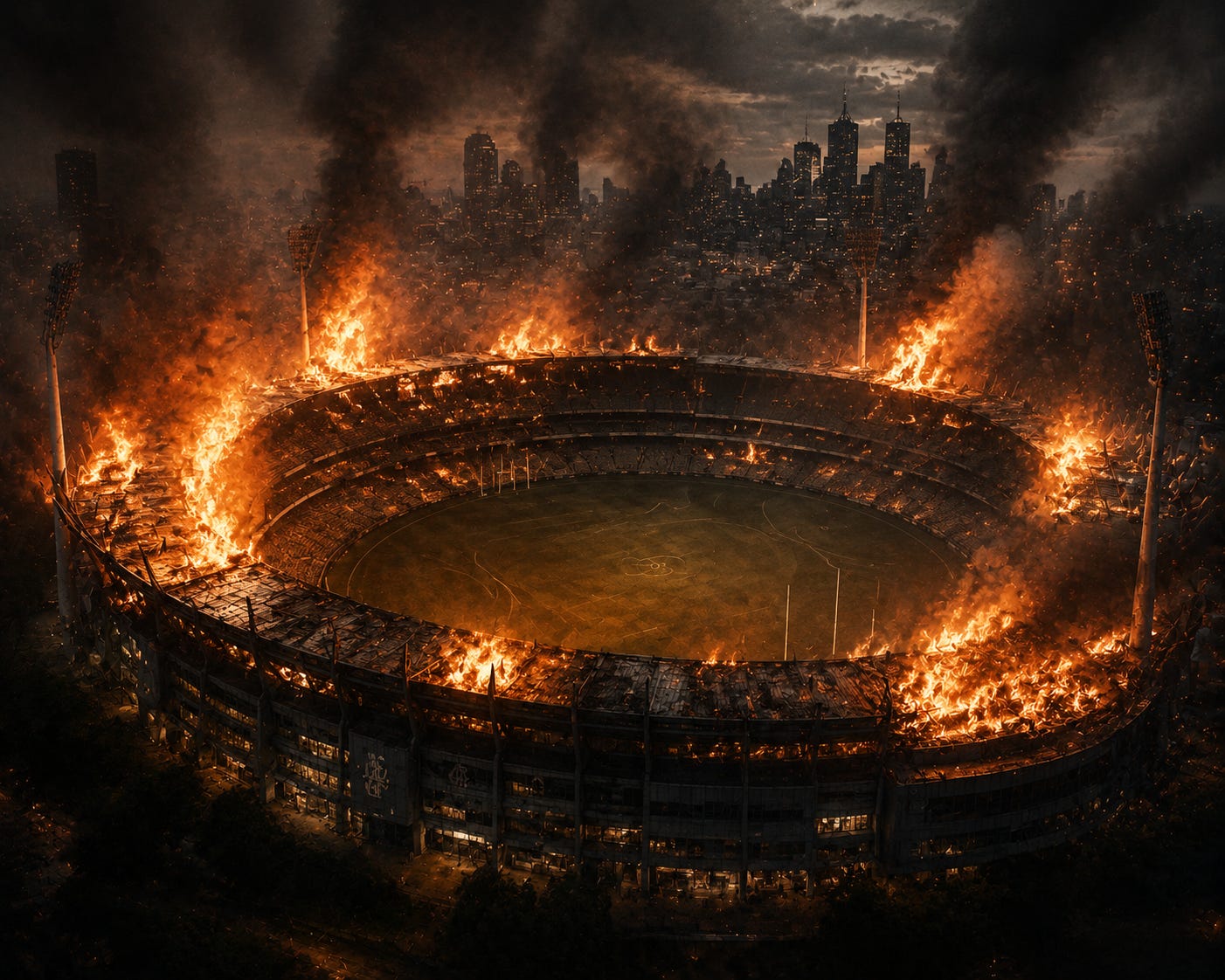
Don’t Let Terror Change Who We Are: Holding Our Humanity in a Polarised World
Alex Vickery-Howe looks beyond winners, losers, and ‘sides’ to disrupt the binary illusion at the heart of public debate and political sledging.
Prime Minister Anthony Albanese has recently delivered a calm and rational address to Parliament in response to political unrest surrounding Israel and Gaza:
We will continue to understand that there is a need in this country, as well as globally, for some nuance in this debate and that the debate is not advanced by people thinking it’s like a football team where you have to support 100% one side or the other. That does not advance peace.
In the current febrile climate, the Prime Minister’s take will be unpopular. Asking either side of politics to reflect on their own actions and behaviour raises an immediate and often vitriolic backlash. Politics has indeed become “like a football team” and reasoned debate that might lead to stable, lasting, concrete solutions is seen as ‘weakness’, ‘fence sitting’, or ‘betrayal’. Albanese is correct when he criticises the blinkered rhetoric and the public violence that has broken out in response to clashes in Australian capitals marking the visit from Israeli President Isaac Herzog.
This is the same Australian Prime Minister who has consistently advocated for a two-state solution in Gaza and who has officially recognised a Palestinian state. There are many legitimate criticisms to be made of the current Labor government, especially in terms of ongoing environmental failings and a reluctance to address the cost of living crisis through meaningful tax reform. Attacking Albanese over his measured response to the devastating Bondi massacre isn’t, however, a fair verdict.
These attacks have more to do with naked opportunism and political grandstanding than objective judgement, as the BBC’s Helen Livingstone captured in the aftermath of the event:
While families were waiting to bury their loved ones, a conveyor belt of politicians—including the opposition leader—visited the scene to apportion blame. Populist leaders came to rail against immigration. Prominent businesspeople popped by to pose with flowers.
Few can doubt the sincerity of former Opposition Treasurer Josh Frydenberg when he addressed the Australian Jewish community, and drew attention to a festering antisemitism in Australian society that had coloured much of the debate in the lead up to the Bondi tragedy. Frydenberg has firsthand experience of the discrimination Jewish people continue to face in Australia. His warnings are timely.
The Guardian’s Penry Buckley has compiled a list of some of the major incidents of antisemitism in Australia raised by Jewish leaders since 2023, adding:
This does not include the hundreds, or by some counts thousands, of incidents that do not make the news—verbal abuse and physical violence, offensive graffiti and acts of vandalism—which groups that track the extent of antisemitism say have risen sharply in two years, even if definitions differ.
Reports from JWS Research as well as independent academic and institutional monitoring, such as Online Hate Prevention Institute, have documented sharp spikes in online antisemitism alongside survey data indicating a growing visibility of antisemitic comments and attitudes. The Executive Council of Australian Jewry (ECAJ) reported significant increases in antisemitic incidents in the years leading up to Bondi, calling it a mainstreaming of what had previously been radical discourse:
We are now at a stage where anti-Jewish racism has left the fringes of society, where it is normalised and allowed to fester and spread, gaining ground at universities, in arts and culture spaces, in the health sector, in the workplace and elsewhere.
I’ve never been a fan of the Liberal-National Coalition; however, being unbiased means admitting when someone you’re politically opposed to has a credible point to make. Frydenberg comes to the table with concrete evidence.
On the other hand, Former Opposition Leader Sussan Ley’s performative attack on Minister for Foreign Affairs Penny Wong felt like a textbook example of what the late British stage director Peter Brook would call ‘deadly theatre’. Ley seemed more interested in confecting outrage and scoring points than in expressing something real.
Whether one agrees with these individual assessments is immaterial—our opinions on political figures are often set in stone, and no amount of ink can shift a boulder—the issue is actually about us.
How do werespond to terror on our shores?
The History
We have witnessed some horrific events over the past few years in relation to Gaza and the West Bank…
The displacement of the Palestinian people over decades and the industrial-scale murder of innocent civilians, calmly cheered on by the Trump administration in the United States, has upended our collective sense of justice. We feel powerless because, largely, we are. In solidarity, a large number of Australians have taken to the streets to protest.
The right to protest peacefully should not be questioned by any government. Albanese would be unwise to open that door. At the same time, the kidnappings, the rapes and the murders carried out by Islamic terrorist organisation Hamas on October 7—too grisly to describe in detail—have been brushed aside by many self-proclaimed ‘activists’ and ‘empaths’ in Australia.
The fact that the Israeli government’s disproportionate response to these sickening attacks against innocent partygoers, innocent elderly citizens—and, let us never forget, innocent babies—has occupied our news cycle for three years cannot mitigate the inconceivable horror of that day.
For many Jewish hostages, that horror stretched on ending in rescue, for some, and cruelly prolonged death for others.
‘Disproportionate’ is euphemistic, nevertheless, as the military response from Prime Minister Benjamin Netanyahu can now be accurately termed ‘attempted genocide’ against the Palestinian people, as described by the United Nations commission of inquiry.
We in Australia are left with two emotionally understandable and yet ethically indefensible perspectives with no way to reconcile them.
Can someone be expected to respond calmly and rationally when their partner, sibling or child is kidnapped and slowly killed by Hamas through starvation or fire? No. Can someone be expected to respond calmly and rationally when their home, their community, and their family are being blown apart by the US-backed Israel Defense Forces? Also no.
But in Australia it should be possible to oppose both of these evils. We can stand against antisemitism and condemn the brutality of Hamas while at the same time rejecting the pitiless expansionist policies of the Netanyahu government. These positions are not mutually exclusive. Human beings can contain multitudes.
Equally, it should be possible to concede that some of these local protests have spilled into civil unrest while at the same time acknowledging that the police response has crossed the line into wanton violence, as reported by Amnesty International:
The rights to freedom of expression and assembly are protected under international law. As a State party to the International Covenant on Civil and Political Rights (ICCPR), Australia has a clear obligation to respect and uphold these fundamental human rights—this includes facilitating people exercising their right to peaceful protest.
The challenge for the Labor Government now is to find a way forward. The data around antisemitism must be acknowledged, yet the right to protest peacefully is enshrined in Australian law and should never be impugned. It is not an ‘either/or’ situation. It is not “winner takes all”. It is not, as Albanese rightly points out, a “football team”…
The Balance
Chants of “Globalise the intifada!’ and “From the river to the sea!” are not mere slogans. These words carry enormous political and cultural weight that many local protestors fail to contextualise.
They can be hateful. From the Jordan River to the Mediterranean Sea is a very specific chant with a very specific meaning. The State of Israel is in the geographic middle of that chant.
For some, those words express a call for Palestinian sovereignty across occupied land; for others, they herald the dismantling of Israel as a Jewish state. While advocates for either side may debate the semantics, it is difficult to foresee any outcome wherein a well-founded interpretation of a violent threat can be justifiably or even cogently ignored; the meaning of those words may be contested, but the geography they engulf is indisputable.
Globalise the intifada, similarly, is a call to take a local struggle and make it global. The Palestinian intifadas of 1987-1993 and 2000-2005, as well as the 7 October 2023 massacres, included violent—and, if we are to take language seriously, violently murderous—assaults on civilians.
Pro-Israel voices maintain that employing this exact language and invoking this exact history of violence is a dog whistle for antisemitic discourse. They point to the many scholars, governments and civil rights groups who believe these slogans explicitly call for the assaults and the murders to spread internationally. When applied in the context of the tragedy in Bondi, their argument is that allowing these slogans to circulate in public spaces is irresponsible and inflammatory, as Frydenberg and others have expressed.
Pro-Palestinian voices argue that the slogans express empathy with the Palestinian people and raise further awareness of the suffering in Gaza, for which they will broker no excuse. These voices declare that attempts to prohibit their favoured words and slogans in Australian cities are oppressive, reflecting only political or communal pressure on the government. They maintain that these slogans are benign in their preferred context, and that any narrative that demonises the Palestinian cause must be vociferously opposed.
A third group simply waves signs.
Above the rhetorical clash, but beneath the rhetorical class, the civilians and their children are powerless to sway either Hamas or the IDF, yet their lives are defined by the destructive appetites of their oppressors. A common thread can be woven by separating people from ideology and tying us back to grassroots issues: ensuring access to and protection of medical personnel in Gaza; clarifying the future of Palestinian refugees; advocating globally for a sustained ceasefire; and ultimately supporting a two-state solution that rejects the concept of genocide (rhetorical or otherwise.)
We can be critical of some protestors while being critical of some police officers. We can acknowledge the nuance by admitting that not all protestors are alike, just as not all police officers are alike…
We can see this as complex. Because it is.
Some protestors want to agitate, to push a biased or racist agenda, to manage their personal brand, to ‘educate’ their sceptics and to condescend from shaky ground, while others are exercising their democratic right to speak freely and to take a peaceful, public stand for something they believe in.
Some police officers are there for the fight, to quell dissent, to push protestors down and punch them repeatedly, while others are responsible professionals striving to keep the public safe.
We simplify these issues at our peril.
The Choice
Recognising the grey in all of this conflict is not an act of treachery or naïveté. It is not apathetic, it is not anaemic, and it is not a moral failing; it is an attempt to acknowledge the humanity in everyone.
We can condemn antisemitism while condemning Islamophobia. This is crucial. We don’t have to prioritise one over the other. We shouldn’t rank them. Among the many heroes of Bondi was 43-year-old Syrian-Australian Ahmed Al Ahmed. Jumping from behind a parked car, Ahmed wrestled a weapon from cowardly terrorist Sajid Akram and was subsequently shot five times by Sajid’s radicalised son Naveed Akram, currently in federal custody.
Ahmed Al Ahmed has lost all feeling in his hand as a result of his heroism and is truly lucky to be alive. He is also a practicing Muslim. While interviews with Ahmed read like an exemplar in kindness, charitableness and selflessness, the tale of the embittered father and son duo of Sajid and Naveed reads like two sad, lonely men who turned to extremism to justify personal and romantic shortcomings. Theirs is a terrorism born from misogyny as well as antisemitism and a perversion of Islam.
The contrast between compassionate Ahmed and the vile Akrams is striking. Only the most divisive among us would lump them together. We are foolish when we categorise varied human experiences into broad and childishly one-dimensional terms. This is the danger of choosing a football team and constructing a morality that takes sides: we stop seeing actual people.
The purpose of terror is to divide us. To change us. Whether it is the destruction of the World Trade Center on 9/11, the London Tube bombings of 7/7, the October Hamas massacres, or the devastation of Bondi, the goal is the same:
Make us afraid.
Make us angry.
Make us turn on each other.
Some would say media reporting on these events is feeding the same flame, which is why advocating steadily for cool heads to prevail is an astute move from the Prime Minister. More recent data from JWS Research, as reported on ABC’s Insiders, has revealed that approximately 70% of Australians are concerned about tensions between different political and cultural groups, and 67% don’t want international disputes impacting Australia; a sobering temperature check amid heightened tensions following events such as the Bondi attack. Division, like media bias, will cripple our democracy.
Our outrage is not baseless, our sense of injustice far from unfounded, but the violence on Australian streets is playing directly into the hands of those who would perpetrate these inhumane acts against us. Nobody should force their friends into further division. Nobody should demand absolute obsequiousness to a binary view. We don’t have to conform to hatred. We don’t have to bow to one ‘team’ and condemn those outside it.
For months, I’ve been flooded by demands from people in my social circle—dragged to either side of the centre square—to pick a side and commit to it. This includes surrendering my right to question them and to instead be ‘educated’ by whatever the algorithm has spat out in their favour.
Don’t play by partisan rules. There is another way.
Picked up where you left off