I Don’t Like It: Satire Has Changed Sides
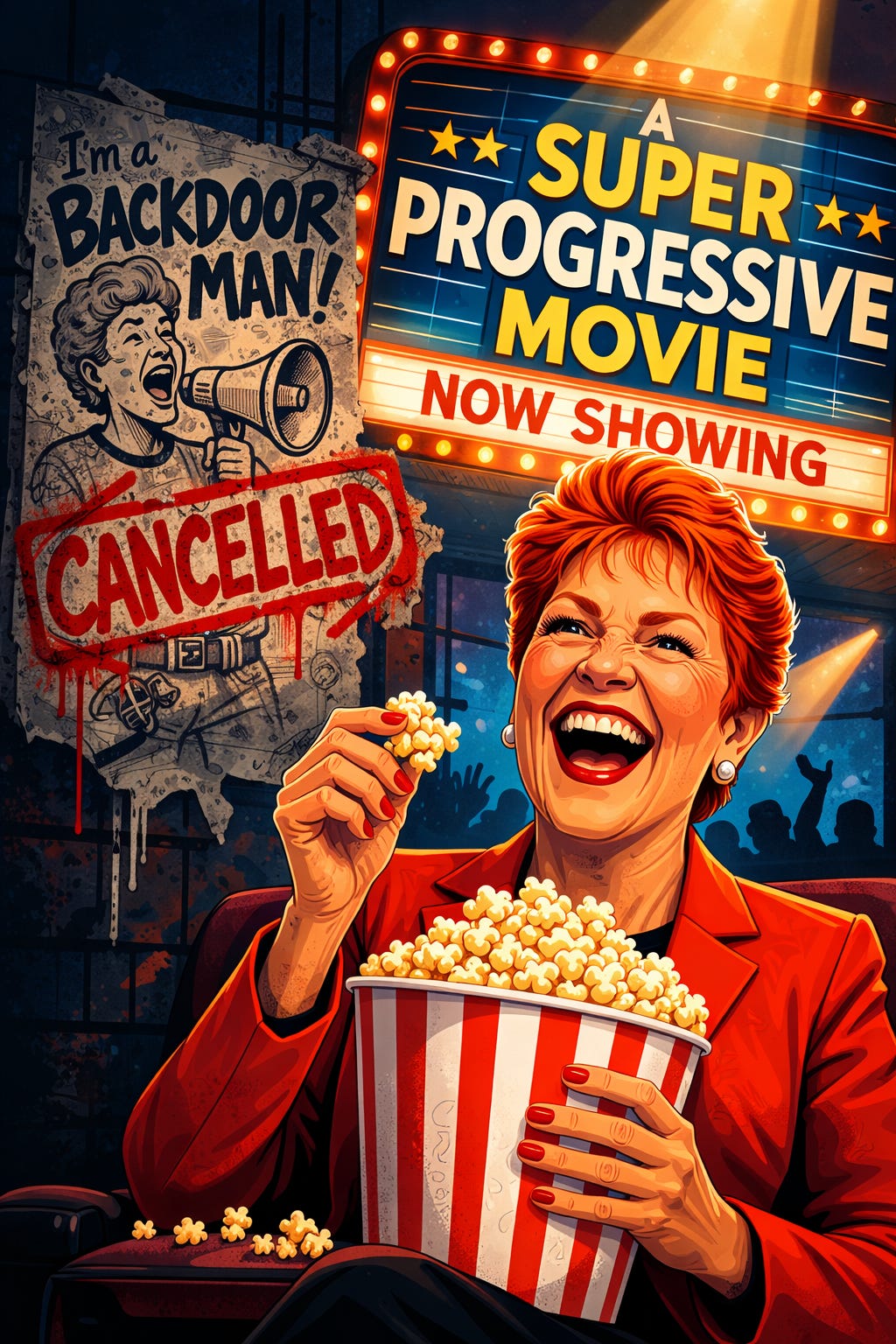
Alex Vickery-Howe fondly recalls when we were all the front-row audience of the Backdoor Man.
Picture this.
Remember it, if you can.
It’s 1998. You’re at a party. Maybe you’ve had a few drinks, or one of those interesting cakes. You lift yourself from the couch and you turn, groggily, to take in the latest episode of Rage, back when Rage was…all the rage.
The song is ‘I Don’t Like It’ by Pauline Pantsdown, a pastiche of clips from One Nation leader Senator Pauline Hanson taken out of context, spliced together and set to catchy muzak. It’s as ‘90s as one-strap overalls, Friends and Beanie Babies…and it was always on in the background of teenage parties. The creation and alter ego of musician and satirist Simon Hunt, Pauline Pantsdown was a passing icon but much beloved.
The man behind the drag persona knew what he was doing and pitched it savagely. Inspired by new sound editing technology (‘90s ‘new’) and influenced by a global arts activism movement that was ‘appropriating things from the art world and from the media’ to produce their own work in a ‘pre-internet’ age, Hunt found the perfect comic foil in Hanson. ‘I Don’t Like It’ is a cultural curio that reflects a very different moment in the Australian popular psyche. Hunt struck a nerve and made Hanson his clown.
The then casual University teacher had been working towards his act for a while. Collecting clips like a devilish magpie, Hunt delighted in lampooning the soundbites of right-leaning political figures, such as the Reverend Fred Nile, who directed his venom at Sydney’s gay and lesbian community over several decades. If Nile was fun for target practice, Hanson was the bullseye.
When Pauline (in)famously said ‘I don’t like it’ in response to a journalist asking her for her views on the Gay and Lesbian Mardi Gras—and followed it up with ‘…because it’s promoting something that is not natural’—Hunt had the beginnings of what would be his most popular song. Proceeded by ‘Backdoor Man’, in 1997, which shot to the top of Triple J as the most requested song for 11 straight days, ‘I Don’t Like it’ saw Hunt’s popularity take him to number 10 at the Aria Charts.
Hanson wasn’t a fan.
The ‘free speech’ campaigner did everything she could to shut Hunt’s act down, including applying for—and winning—an injunction to stop the ABC from playing ‘Backdoor Man’. The senator couldn’t take a joke, explicitly telling reporters outside the court that ‘freedom of speech does not extend by allowing people the right to defame others and tell lies.’
Reflecting on this period, Hunt describes Hanson’s rhetoric during her Maiden speech to Parliament and in interviews thereafter as ‘words from a different time’.
How wrong that has proven to be.
Say what you like about ‘90s politics, I believe there’s a strong argument that Pauline Hanson being the butt of the joke and furiously censoring her cleverer critics is the natural state of affairs. I miss a time when the right was laughable, and the left was gleefully deploying tongue-in-cheek humour. I remain a Simon Hunt fan. I wish his perspective had endured.
2026 is a markedly different landscape…
Pauline Hanson has recently released her own attempt at satire. The feature length version of Hanson’s Please Explain animated web series (a cornerstone of her successful social media campaign), A Super Progressive Movie has made much more of a cultural impact than it ever deserved to. This impact is thanks, at least in part, to the desperate attempts to censor its release.**Left-wing protestors have blown kazoos and set off stink bombs to stop Hanson and her supporters from watching their puerile cartoon.
The brainchild of Melbourne-based writer-animators Mark Nicholson and Sebastian Peart of Stepmates Studios, A Super Progressive Movie represents Hanson turning the tables on her critics. She is the one making the jokes now, and her detractors have switched from speaking out smartly to shouting over her. This is a sad development.
The feature comes with its own song: a late rejoinder to Hunt’s work, perhaps, in the form of Neighbours alumnus—and fellow ‘90s relic—Holly Valance singing ‘Kiss Kiss (XX) My Arse’ for the benefit of Hanson’s ‘anti-woke’ base. This song topped the iTunes best-selling chart, which is no mean feat (despite what many of us would rather choose to believe) only to be (temporarily) pulled by Apple Music. Valance revelled in her sudden return to relevance, and took the opportunity to sink her stilettos in. She, like Hanson, is riding a wave of popularity that would’ve seemed unthinkable a mere 10 years ago.
It should still be unthinkable.
While a cursory glance at the material is enough for most viewers to roll their eyes and move on, those who fall prey to social media algorithms—be they young or old, Alpha or Boomer—now see One Nation as the legitimate victim of cancel culture. Nicholson and Peart have certainly done wonders for the rehabilitation of Hanson’s image, and Valance will be in the Australian news cycle for as long as the outrage machine feeds her; nevertheless, the talent or otherwise of those involved is not the core issue. The core issue is that the narrative has switched, and it needs to be switched back.
With the Coalition fractured and Sussan Ley mercifully axed after struggling to pretend she was leading a united and coherent party, recent polling indicates support for One Nation has surged to 26 percent. Many partisan left-wing outlets would like to pretend Hanson has no chance of making an impact. Their rhetoric is transparently blinkered and unhinged, as Hanson continues to laugh. This weekend’s South Australian election will be the test of Pauline’s new villain era, and an indicator for the broader Australian community as to whether we will follow Trumpism in the US and Faragism in the UK. My hope is that we won’t, but my gut feeling is that rising support for One Nation will be evident on election night, even in the inner-city seats.
Under a preferential voting system, it is highly unlikely that anyone will have to type the words ‘Prime Minister Hanson’ anytime soon, yet for a politician who was so clearly, and conclusively, the target of ridicule for her xenophobic (‘please explain’), homophobic and antiquated social views to now not only be back in the spotlight but basking all the way is a remarkable turn of events. For that same politician who once shouted impotently at clever artists to now be using satire so effectively is a worrying reversal. It should be a wakeup call for everyone who would prefer to see sanity in the lodge.
If someone out there has their head around Pro Tools, now’s the time. Perhaps we can get ‘90s idol Natalie Imbruglia or Home and Away alumnus Kate Ritchie to launch a counter-protest song. Whatever comes next, it needs to be sharp, and it needs to be confident. It needs to follow the Simon Hunt tradition of biting satire punching up at bigotry and taking the power back. Shouting and screaming in cinema foyers is an excellent strategy if the only goal is to play into the hands of Sky News pundits, Valance’s PR team, and ultimately Hanson herself. All of them are enjoying the free publicity they’ve been given.
Another right-wing personality in dire need of a foyer protest to boost her profile is Melania Trump, whose own attempt at silver screen success, the ‘wittily’ titled Melania, is playing to thunderous silence at a theatre nowhere near you. Some things exist beyond the realm of satire.
Picked up where you left off